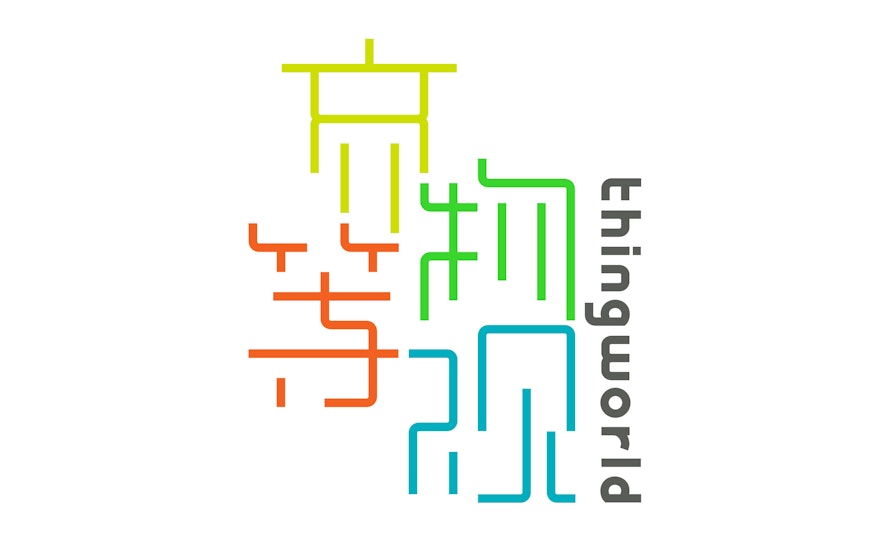
The identity centers this core character as typography, logo, mascot, and the structure of its reactive design system. They modernized the character through clean, geometric forms inspired by the ichimatsu moyo (市松模様) checker pattern, which represents uninterrupted prosperity and growth.


In layouts, the character defines a grid system grounded in the four corners, articulating consistency, craft, and modulation. Stretching and adapting across content and scale, this modularity becomes a metaphor for Chiba Tech’s global partnerships.


Pentagram created two custom typefaces: one inspired by the ichimatsu pattern, and a monospace font derived from the square form of the core character. As these Latin and Japanese forms encounter one another across Chiba Tech’s visual identity, they function much like two students from opposite sides of the world.


Anthropomorphized, the “Chibuggy” draws, lasercuts, and jumps across the brand system, providing expansive opportunities for application. Chibuggy is emotive, announcing acceptances, enthusiastically campaigning, and bringing warmth to an otherwise rigid system.


The Chiba Institute of Technology is the oldest private technology institute in Japan. Established in 1942 as the “Kōa Institute of Technology”—“Kōa” meaning “Asia wakes up”—the school captured the progressive essence of national policies promoting Asian prosperity and technological innovation. Today, there remains a growing demand for technology education in Japan. By 2040, the country is projected to face a shortage of 3.26 million workers in fields related to artificial intelligence and robotics. To address these challenges, the Chiba Institute seeks new pools of prospective students internationally, and a refined brand identity to attract them. To formalize the school’s transition into its next chapter, Giorgia Lupi and her team shortened the name to “Chiba Tech” and unified the brand’s visual expression. The result evokes a strong sense of pride in the school’s legacy while being systematic and clever, demonstrating Chiba Tech’s drive to be in the cutting edge of international technology education.
Interested in highlighting the duration of Chiba Tech’s progressive contributions to Japan, Lupi and her team looked to its original 1942 character, taking it as the foundational form for the system. The identity centers this core character as typography, logo, mascot, and the structure of its reactive design system. They modernized the character through clean, geometric forms inspired by the ichimatsu moyo (市松模様) checker pattern, which represents uninterrupted prosperity and growth. These visual nods to Chiba Tech’s legacy are site-specific, layering a sense of pride in place with traditional visual metaphors. The idea and execution speak to a long heritage while being digitally forward—the modulating squares hint at pixels rearranging on the screen.
Deftly balancing latin letterforms with Japanese characters, Pentagram created two custom typefaces: one inspired by the ichimatsu pattern, and a monospace font derived from the square form of the core character. The former offers opportunities for illustrative patterns to complete the system, while the latter joins the core character harmoniously in the lockup. As these Latin and Japanese forms encounter one another across Chiba Tech’s visual identity, they function much like two students from opposite sides of the world.
Though the core character is seen as typography to Japanese speakers, it often operates as a symbol for an international audience. Throughout the system, it oscillates between typography and typography as form, embodying an expansive and imaginative ethos. In layouts, the character defines a grid system grounded in the four corners, articulating consistency, craft, and modulation. Stretching and adapting across content and scale, this modularity becomes a metaphor for Chiba Tech’s global partnerships: the new design system is an elegant collaboration between Swiss and Japanese sensibilities.
The core character also takes on more expressive forms, transforming into a mascot. Anthropomorphized, the “Chibuggy” draws, lasercuts, and jumps across the brand system, providing expansive opportunities for application. Chibuggy is emotive, announcing acceptances, enthusiastically campaigning, and bringing warmth to an otherwise rigid system. Embodying the imaginative nature of Japanese culture, Chibuggy is inspired by traditional Japanese folklore (tsukumogami 付喪神) and objects, concepts, and phenomena that are personified (moe gijinka 萌え擬人化). Guided by the same design principles as the larger system, Chibuggy is an approachable and welcoming complement to its stoicism.
An extensive and immersive cultural research phase was essential for the success of this project. Lupi worked closely with Pentagram Senior Designer Yoshi Torralva to identify and maintain academic cultural pillars specific to Japan in the design. The challenge was balancing a visual tradition with universal elements to reach new audiences. Harnessing personal connections, interviews with Chiba students and faculty, and time immersed in Chiba’s campus life, Torralva and Lupi developed an identity that elegantly incorporates touchpoints on two spectrums: from traditional to contemporary and local to global. This project owes great credit to the generous community who brought incredible inspiration and cultural insights to its conceptual direction.
Chiba Tech’s new identity balances a respect for tradition with forward-looking imagination. Tributes to Japanese culture and the school’s legacy conjure pride, while its expansive, principled design system reflects the innovation and ingenuity that the school instills in its students. Every element of the brand—even its color system—is precisely structured to resonate with students who value clarity, methodology, and systems thinking. As Chiba Tech ushers in a new chapter as an international hub of technology education and innovation, its refreshed identity serves as both a celebration of its heritage and articulation of its ambitions.
Office
- New York
Partner
Project team
- Yoshi Torralva
- Britt Cobb
- Ryan Yan
- Phillip Cox
Collaborators
- Kaori Torralva
- Chinatsu Watarai